
Open State vs Closed State NEET Counselling 2026: Domicile, Private Seats and Better Options
Quick summary
Understand open-state and closed-state NEET counselling for 2026, including domicile, private seats, eligibility, fees and registration strategy.
Main explanation
Quick Answer
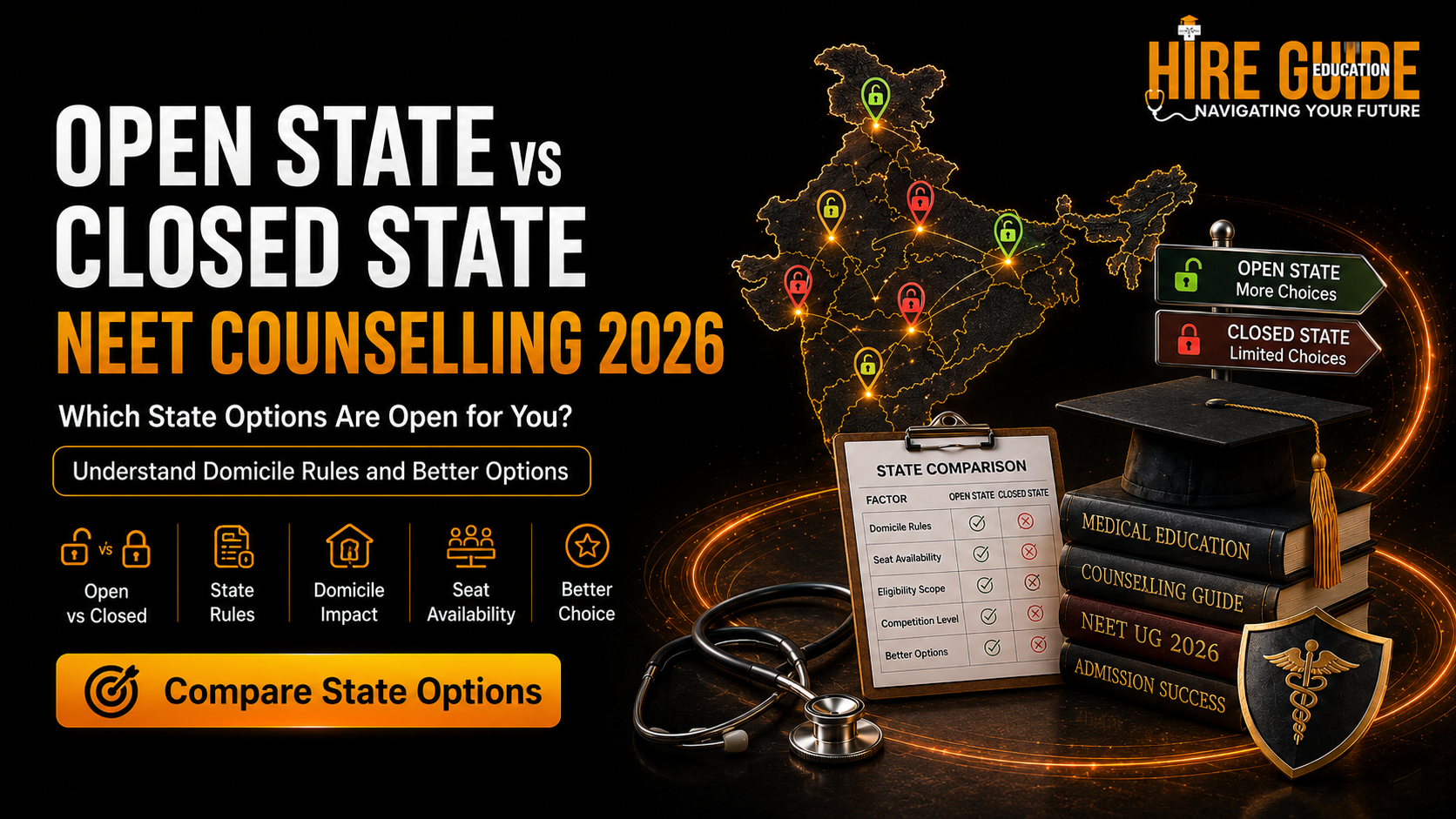
Open state and closed state are informal counselling terms, not one national legal classification. An open state usually allows non-domicile candidates to compete for some private, management or NRI seats. A closed or restricted state limits more seat categories to domicile, local or institutional candidates. The current State prospectus is the only final source.
Why This Topic Matters
Students often register in many states after seeing an online open-state list. Some later discover that the useful seat category is restricted, the fee is too high or a local certificate is required. The correct approach is to classify each seat type, not only the state name.
Why Open and Closed Are Informal Terms
A State authority may open management seats to all-India candidates while keeping government quota seats for domicile candidates. Another State may allow non-domicile applications but give them access only after local candidates or under a separate category.
Therefore, one State can be open for one seat type and restricted for another. Avoid a permanent coloured map without reading the current prospectus.
Government Seats and Domicile
State government quota seats commonly require domicile, residence, schooling or another notified connection. Exceptions may apply to parents in service, institutional candidates, migrants or special categories.
A current address or Aadhaar card does not automatically prove domicile. Use the exact certificate and eligibility clause.
Private and Management Seats
Some State counselling authorities permit candidates from other states to apply for management or open-category private seats. Fees are often higher than State government quota seats.
Check whether non-domicile candidates receive equal consideration from the first round, are considered only in later rounds or are restricted to specific colleges.
NRI and Minority Seats
NRI seats require separate eligibility, sponsorship and documents. Minority seats may have religious or linguistic conditions. These routes should not be labelled open merely because candidates from other states can register.
The candidate must satisfy the exact seat-specific rule.
How to Test Whether a State Is Useful for You
Read the eligibility chapter and find the seat categories available to non-domicile candidates. Then check participating private colleges, tuition, security deposit and previous closing ranks.
A State is useful only when the candidate is eligible for an affordable and acceptable seat with a realistic rank chance.
Registration Cost and Time
Multiple State registrations can require application charges, security deposits, document uploads and separate choice filling. Registering everywhere without analysis wastes money and attention.
Create a priority score based on eligibility, college quality, total cost, historical chance and willingness to relocate.
Open-State Choice Strategy
For each useful State, build a separate preference list and calendar. Keep college and seat codes exact. Do not mix management, government quota, minority and NRI cutoffs.
Prepare documents early because non-domicile applicants may need additional declarations.
When a Restricted State Can Still Matter
A State may be restricted for government seats but still offer deemed universities through MCC or a small number of open private categories. The student should check all routes before removing the State completely.
MCC deemed choices should remain in the MCC list, not in the State list.
Simple Planning Flow
```text Choose a State
Read current prospectus
Find seats open to non-domicile candidates
Check fees, colleges and realistic cutoff
Score the State for usefulness
Register only where the route is practical ```
Comparison Table
| Question | Open-type position | Restricted-type position |
|---|---|---|
| Can non-domicile apply? | For some notified seats | Limited or no access to key seats |
| Government quota | Usually still domicile-based | Domicile/local rules dominate |
| Private seats | Some management/open seats available | More categories restricted |
| Fees | Often higher for open private seats | Depends on local quota |
| Main document | NEET + notified declarations | Domicile/local eligibility proof |
| Best use | Expand realistic private options | Focus on domicile or special eligibility |
Practical Student-Parent Example
A Maharashtra student may be technically allowed to register in another State, but if the only open seats cost more than the family budget, that State is not a practical option. Eligibility alone is not enough.
Action Checklist
- Use the current State prospectus.
- Identify seat categories open to non-domicile candidates.
- Check whether access starts in the first round or later.
- Compare full fees and security deposit.
- Use seat-category-specific cutoffs.
- Confirm document and registration deadlines.
- Register only in useful States.
- Maintain separate choice lists and calendars.
Common Mistakes to Avoid
- Treating open state as an official permanent label.
- Assuming non-domicile candidates can take State government seats.
- Registering without checking the open seat fee.
- Using one State's category name in another State.
- Comparing local and management cutoffs.
- Following an old open-state map.
Frequently Asked Questions
Is there an official national list of open states?
No. Eligibility is defined by each current State prospectus and seat category.
Can a non-domicile candidate get a private MBBS seat?
In some States and seat categories, yes, subject to current rules and fees.
Does open state mean low fee?
No. Open private or management seats can be expensive.
Can domicile be proved by Aadhaar?
Aadhaar alone does not automatically satisfy every State domicile rule.
Should I register in every open state?
No. Register only where eligibility, fees, colleges and rank chance are practical.
Useful Hire Guide Education Tools
- NEET UG Counselling HubNEET UG Counselling Hubhttps://hireguideeducation.org/counsellings/neet-ug
- NEET College PredictorNEET College Predictorhttps://hireguideeducation.org/predictor
- Cutoff ExplorerCutoff Explorerhttps://hireguideeducation.org/cutoff
- Medical College DirectoryMedical College Directoryhttps://hireguideeducation.org/colleges
- Choice Filling ToolChoice Filling Toolhttps://hireguideeducation.org/choice-filling
- Counselling PlansCounselling Planshttps://hireguideeducation.org/pricing
Related Reading
- State Quota vs AIQState Quota vs AIQhttps://hireguideeducation.org/blog/state-quota-vs-all-india-quota-neet-ug-2026
- Low Budget MBBS CollegesLow Budget MBBS Collegeshttps://hireguideeducation.org/blog/low-budget-mbbs-colleges-india-2026
- NEET Counselling DocumentsNEET Counselling Documentshttps://hireguideeducation.org/blog/neet-counselling-documents-2026-mcc-state-checklist
Official Sources
- NEET UG 2026 Information BulletinNEET UG 2026 Information Bulletinhttps://cdnbbsr.s3waas.gov.in/s37bc1ec1d9c3426357e69acd5bf320061/uploads/2026/02/202602231394640855.pdf
- MCC UG Medical CounsellingMCC UG Medical Counsellinghttps://mcc.nic.in/ug-medical-counselling/
- NTA NEET UG Official PortalNTA NEET UG Official Portalhttps://neet.nta.nic.in/
Stay Connected with Hire Guide Education
- Join the NEET UG 2026 WhatsApp ChannelJoin the NEET UG 2026 WhatsApp Channelhttps://whatsapp.com/channel/0029VbCkYqA1t90krIYMBV1A for official counselling alerts, schedules and reminders.
- Follow Hire Guide Education on InstagramFollow Hire Guide Education on Instagramhttps://www.instagram.com/neetcounselling.hireguide/ for short counselling explainers.
- Subscribe to the Hire Guide Education YouTube ChannelSubscribe to the Hire Guide Education YouTube Channelhttps://www.youtube.com/@Hireguideedu for detailed guidance videos.
- Explore Hire Guide EducationExplore Hire Guide Educationhttps://hireguideeducation.org/ for the predictor, cutoff data, colleges and counselling services.
Final Takeaway
Do not ask only whether a State is open. Ask which seat is open, who is eligible, what it costs and whether the student would actually join.
*Disclaimer: This article is for counselling awareness and planning. The latest official eligibility rule, prospectus, seat matrix, fee order, allotment result and reporting instruction issued by the competent authority will remain final.*